


Destination Colle Val d’Elsa
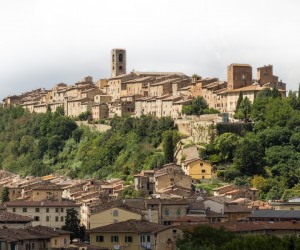
Crossed by the Via Francigena, Colle Val d’Elsa is known as the City of Crystal, a place where medieval history, contemporary art, river landscapes, and ancient artisan traditions coexist harmoniously.
Its origins date back to prehistoric times, but the first documented urban development took place between the 10th and 12th centuries. The city was formed as a collection of three distinct centers – Castello di Piticciano, Borgo di Santa Caterina, and Piano – taking on a strategic role along the Via Francigena, an important medieval trade and pilgrimage route.
In the 13th Canto of the Purgatorio, Dante recalls the Battle of Colle, between Guelphs and Ghibellines, which handed the small town over to Florence.
Over the centuries, Colle di Val d’Elsa became firmly part of Florence’s political sphere. 1592 was a key milestone in its history: Pope Clement VIII established the diocese of Colle di Val d’Elsa, officially granting it city status. In this period of growth and prestige, the Tuscan town was the birthplace of important figures in art and architecture, including Arnolfo di Cambio, while the Usimbardi family played a significant role in its urban, artistic, and cultural development.
Starting in the 1800s, Colle di Val d’Elsa deeply transformed its economy, gradually moving away from traditional activities related to paper production and ironworking to specialize in glassmaking. The opening of the first glassworks in 1820 marked the beginning of an extraordinary growth that would make the city the Italian capital of crystal. Even today, the area produces about 15% of the world’s crystal and over 95% of Italy’s, a record that has earned it the prestigious nickname of ‘the Bohemia of Italy’.
The architecture of Colle di Val d’Elsa tells the story of the city’s evolution through the centuries. The oldest part, known as Colle Alta, keeps its medieval layout with narrow streets, stone palaces, and charming squares, all dominated by the massive Castle and the Co-Cathedral of Saints Albert and Martial. Between the Renaissance and the modern age, the city was enriched with elegant noble buildings, churches, and convents, also thanks to the contribution of the Usimbardi family. From the 19th century onwards, the development of the crystal industry encouraged urban expansion down towards the lower part of the city, where new neighborhoods, workshops, and public spaces were built. Today, Colle di Val d’Elsa represents a harmonious mix of medieval, Renaissance, and industrial architecture, showcasing a history of continuous transformation and appreciation of the area.
From a nature and landscape perspective, one of the most popular routes is the SentierElsa, a nature trail that follows the course of the river through clear waters, lush vegetation, ancient hydraulic works, and small waterfalls.
The glassmaking tradition of Colle di Val d’Elsa dates back to the Middle Ages. As early as 1331, the town statutes documented the presence of furnaces for producing glasses and other glass items, highlighting a craft that would deeply shape the city’s identity. At first, production was limited to common glass, but over the centuries the techniques improved to make it possible to produce crystal.
A decisive turning point came in 1820, when the French glass master Francesco Mathis founded a modern factory that was set to revolutionize the industry. Thanks to the introduction of innovative techniques, the glass produced in Colle di Val d’Elsa stood out for its exceptional clarity and high quality. In the following years, other entrepreneurs and glass masters helped to further refine the production processes, until in 1963 they achieved crystal that could compete with the most prestigious English and French productions.
Creating a crystal object is still a process that requires skill, precision, and great craftsmanship. After melting the raw materials in ultra-high temperature ovens, the material is shaped through blowing, pressing, or handwork. Each piece is then finished with delicate grinding, engraving, polishing, and quality control. Many of these steps are still carried out by hand by expert master artisans, making every creation a unique piece.
In recent decades, the crystal district has managed to combine tradition and innovation, investing in the development of increasingly sustainable materials. Several companies have actually introduced eco-friendly lead-free crystals, capable of maintaining the same brilliance, transparency, and durability thanks to new formulations. This evolution has allowed the sector to meet modern environmental demands without giving up the high-quality standards that have made Colle di Val d’Elsa famous worldwide.
To dive deeper into this amazing tradition, you can visit the Crystal Museum, which showcases over two centuries of industrial and artisanal history through old work tools, machinery, artworks, and precious artifacts. The exhibition journey tells the story of how crystal making evolved and the role it played in the economic, cultural, and identity development of the city.
Colle di Val d’Elsa is a city that harmoniously combines the charm of its medieval heritage with the lively spirit of contemporary creativity, the excellence of traditional craftsmanship, and an exceptionally valuable natural heritage. Strolling along the Via Francigena https://www.visitcolle.it/via-francigena/, discovering works of art, watching crystal being crafted, and letting yourself be captivated by the enchanting landscapes of the Elsa River means experiencing a true adventure in the heart of Tuscany, where history, culture, and nature come together in a unique balance.