


Going for a stroll in the Maremma
Massa Marittima, Castiglione della Pescaia, Montepescali
We are in the territory of the Metalliferous Hills, which give identity and character to this part of Italy. Starting from Massa Marittima, you immediately enter the mining, hilly land, made up of forests, ancient quarries, and stone villages that define this area. The city itself tells this identity. The Romanesque façades of the cathedral, the narrow alleys, and the sloping squares speak of the wealth built over the centuries thanks to the metals extracted from the Metalliferous Hills. Even today, entering the workshops in the center, one can feel the connection between craftsmanship and native materials: beaten copper, glazed ceramics, olive wood, and small artistic workshops that reinterpret ancient techniques with a contemporary taste.
Leaving Massa Marittima in the direction of the sea, you pass through gentle landscapes, with vineyards, olive groves, and stretches of Mediterranean scrub scented with helichrysum and juniper. Just outside the town, it is worth visiting Lake dell’Accesa, a very clear body of water immersed in the forest, linked to Etruscan settlements and to folk tales that described it as a “bottomless” lake. Here nature still appears intact: herons, reed beds, and sudden silences anticipate the continuous relationship between water and land that will accompany the entire itinerary.
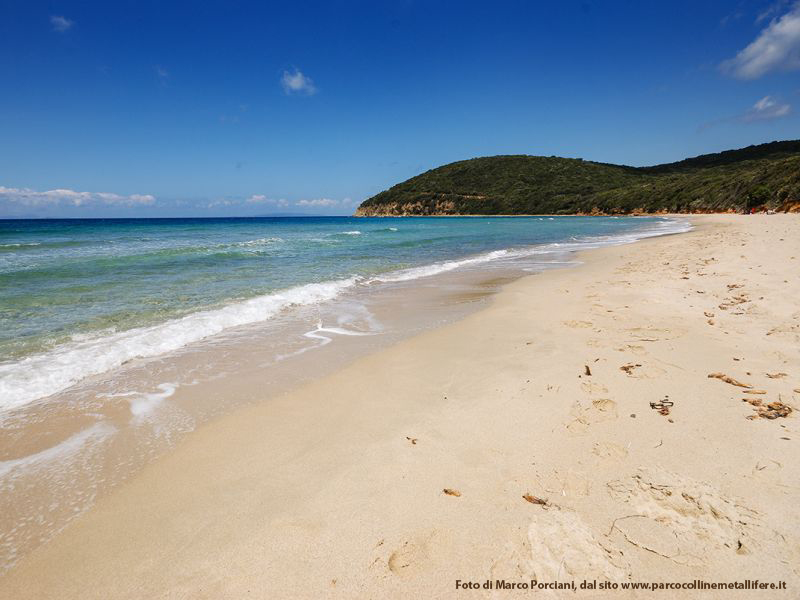
A strip of blue appears on the horizon, it is the sea. The road takes us to places reachable on foot or by bicycle, Cala Martina, Cala Violina, and Cala Civette, small bays still untouched, immersed in the scents and colors of the Mediterranean scrub.
Continuing towards the coast, the Maremma gradually changes its face. The hills open up into plains crossed by canals and pastures, and the large Maremma farms appear. We have arrived in Castiglione della Pescaia; climbing towards the medieval castle, one moves from a maritime atmosphere made of nets, fishing boats, and canals to a maze of stone overlooking the Tyrrhenian Sea. From above, the relationship between the coast and the recently crossed hinterland is clearly perceptible: behind the sea, pine forests, reclaimed marshes, and cultivated hills begin immediately. Handicrafts also change form. Here, one can find workshops related to the nautical world, leatherworking, and Mediterranean ceramics.
Leaving Castiglione della Pescaia, you encounter one of the most fascinating natural areas of Tuscany: the Diaccia Botrona. This enormous wetland is what remains of the ancient Lake Prile, a basin that in the Middle Ages occupied much of the coastal plain. Today it is a reserve where water, sky, and vegetation blend into an almost lagoon-like landscape. Flamingos, Black-winged Stilts, and Marsh Harriers make the area an extraordinary destination for those who love observing nature, especially at sunset.
Resuming the journey inland, the road leading to Montepescali crosses a more agricultural and quiet Maremma. One passes by wheat fields, isolated farms, and rows of cypresses while the profile of the Amiata reappears on the horizon. It is an area where the Lorraine reclamation transformed ancient marshes into fertile land, and the landscape continuously tells the story of the relationship between man and the environment.
The road invites us to visit the Archaeological Park of Vetulonia, one of the most important places to understand Etruscan civilization in the Maremma. Between the 7th and 6th centuries BC, Vetulonia was one of the most powerful cities of Etruria, wealthy thanks to the trade of metals from the Metalliferous Hills and its contacts with the Mediterranean.
Vetulonia was surrounded by wooded and mining hills and overlooked the ancient Lake Prile — now disappeared — which at the time connected the city to the sea. Vetulonia thus controlled both inland and maritime trade routes, becoming a strategic and culturally refined center. Among olive trees, cypresses, and paths, the great Etruscan necropolises emerge with the famous tumulus tombs, monumental constructions of earth and stone that resemble small artificial hills: the Tomba della Pietrera, the Tomba del Diavolino, the necropolises of Poggio alla Guardia and Costa Murata.
In the village there is also the Isidoro Falchi Civic Archaeological Museum, dedicated to the scholar who in the nineteenth century identified Vetulonia after centuries of oblivion. The museum preserves many of the artifacts from the necropolises and allows a better understanding of daily life, funeral rituals, and the high artistic level achieved by the Etruscans of the Maremma.
We resume our journey and Montepescali suddenly appears atop a hill, surrounded by walls and olive groves. It is called ‘the balcony of Maremma’ because from here the view embraces almost the entire path traveled: the sea of Castiglione, the Grosseto plain, the metalliferous hills from which we started.